


CVS top tips for tyre health and safely navigating the roads this Autumn
Autumn is here, and with it, a new set of challenges for your vehicle. As the rain clouds and colder months loom to ensure the optimal handling of your vehicle, keeping on top of the health and condition of your tyres is essential. Find out why and read all about our top tips for getting the most miles out of your tyres.
Let’s talk tread!
When it comes to the safe handling of your vehicle, your tyres are the only contact point between your vehicle and the road. The tread on your tyres plays a vital part in acceleration, braking safely and affects the control you have over the vehicle and the quality of your ride. With this in mind, making sure that they are fit for purpose and in tip-top condition is vital to keeping your car roadworthy.
Recent stats on tyre health and knowledge
According to a survey conducted by the RAC in collaboration with the charity TyreSafe at the start of the year found:
Only 39% of drivers know that the minimum tyre tread allowed by law is 1.6mm, meaning a majority (61%) may be driving on one or more dangerous, illegal tyres
Even more concerning was the evident lack of health and tyre tread checks that drivers were performing
As many as a quarter of drivers (26%) only check tyre tread when they remember to do it or directly before taking a car for its MOT, while 5% never do and wait for their car to fail its annual roadworthiness test before taking any action. Just a third (33%) said they check tyre tread at least every month, with 17% saying they do so every other month and a similar proportion – 15% – only checking them about every six months.
What are the legal requirements for tyres?
According to the Law:Tyres
Tyres MUST be correctly inflated to the vehicle manufacturer’s specification for the load being carried. Always refer to the vehicle’s handbook or data. Tyres should also be free from certain cuts and other defects.
Cars, light vans and light trailers MUST have a tread depth of at least 1.6 mm across the central three-quarters of the breadth of the tread and around the entire circumference.
Motorcycles, large vehicles and passenger-carrying vehicles MUST have a tread depth of at least 1 mm across three-quarters of the breadth of the tread and in a continuous band around the entire circumference.
Mopeds should have visible tread.
Tyre age
Tyres over 10 years old MUST NOT be used on the front axles of:
- goods vehicles with a maximum gross weight of more than 3.5 tonnes
- passenger vehicles with more than 8 passenger seats
Additionally, they MUST NOT be used on the rear axles of passenger vehicles with 9 to 16 passenger seats, unless equipped with twin wheels.
To prove the age of a tyre, it is further required that the date of tyre manufacture marking MUST always be legible.
It is important to remember that should your vehicle not meet these requirements you run the risk a receiving a hefty fine or penalties.
Laws RTA 1988 sect 42 & CUR reg 32
What do the experts recommend to ensure optimal tyre health and value for money?
Safety first
Whilst the legal limit is 1.6mm, it is important to remember that this is roughly the size of a fingernail. Climatic conditions also affect the tyre health and the efficacy of this vital grip. A sudden downpour of heavy rain combined with worn tyres can turn disastrous from one moment to the next, with higher chances of skidding, aquaplaning and increased braking distances by up to 44%.
For safety reasons, we therefore recommend that you change your tyres when they reach 2mm in summer and 3mm in winter to be able to maintain overall good tyre performance in all conditions.”
Dave Reeve – CVS Technician

Under pressure
“By making sure your tyre pressure is at an optimal level as recommended by the manufacturer means your car will be safer, will help reduce fuel consumption and reduce the emissions from your vehicle. It is very easy for tyres to become deflated. Typically, a tyre will lose around 1psi per month. Under inflation can cause inner and outer edge tyre wear. Overinflation can cause centre tyre wear. Either way you will not be getting the most out of them.
Regularly checking tyre pressure should be a part of your tyre maintenance routine. For the best results, we recommend you check your tyre pressure when they are cold; you have driven no more than 2 miles. Most vehicles these days have an inbuilt Tyre Pressure Monitoring system which will alert you to any changes on your dashboard. To find the correct pressure for your vehicle you can refer to your handbook or check the door jamb for the correct PSI levels.
Adam – Senior Technician at CVS
Alignment matters
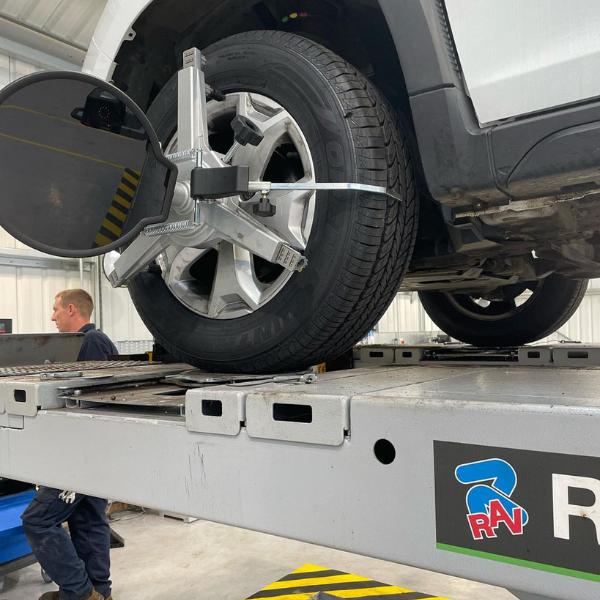
“Heading out of yet another hot Summer in the UK, it is important to know that environmental factors which damage our roads may also have damaged your vehicle. Even hitting a small pothole or a crack in the road can throw your wheel alignment out. This can result in uneven wear and tear on your tyres meaning that you will have to replace them sooner. Misaligned wheels also affect the handling of your vehicle, and will even cost you more in fuel.
As a rule, we always recommend a periodic wheel alignment for all vehicles; every year or 12,000 miles in line with a full service or earlier if you feel like the vehicle isn’t driving as it should.”
Lee Mayne – Director

"*" indicates required fields

Are your tyres in need of some attention? Perhaps you need to book a wheel alignment? Get in touch today! Call us on 01604 961851 Monday – Friday 8am – 5pm or fill out the request a call back form and a member of the team will be in touch.
